
“Make it pop” describes a reaction. It does not tell a writer where the problem is, why it matters, or what would count as fixed. A useful copy review turns reactions into a small decision record: correct the facts, resolve the important questions, then improve the language.
Finish with: one consolidated review packet containing the page's purpose, a prioritized issue list, an owner for each unresolved decision, and a completion check tied to the exact draft being reviewed.
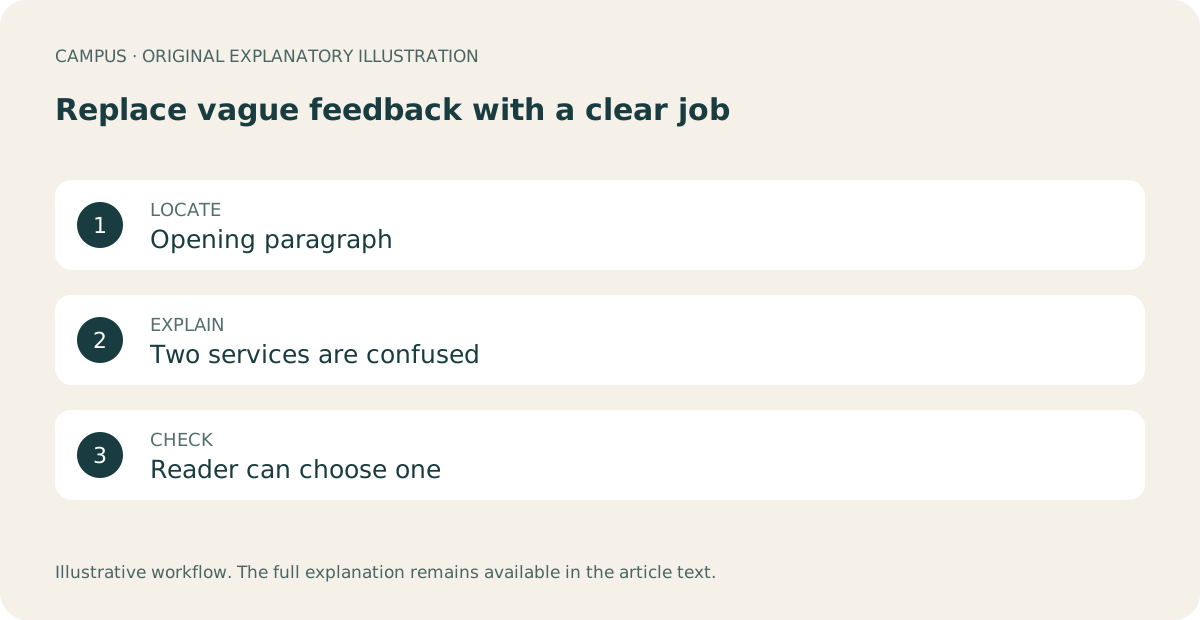
Illustrative review workflow, not a client result. The four-part comment pattern is repeated in text below.
Set the review brief before opening comments
Write down four things at the top of the review document:
- the exact page or file version;
- the reader the page is for;
- what that reader should understand or do; and
- who makes the final decision.
A service page, a free tutorial, and a private handoff document do not have the same job. If the page is meant to help someone decide whether a repair service fits, the review should test scope, process, limits, and the inquiry path. It should not penalize the page for failing to behave like an advertisement.
For a fictional example, use this brief:
| Page | Repair assessment service, draft 04 |
|---|---|
| Reader | A homeowner deciding whether to request an assessment |
| Page job | Explain which repairs are considered, what information to send, and what happens after an inquiry |
| Decision owner | Service owner |
This article reviews a page that already exists. It is different from the Campus content-batch guide, which helps assemble photos and ideas into posts someone can review. Here, the work is deciding what one drafted page must change before it can be accepted.
First pass: facts, permissions, and promises
Before discussing tone, check the statements someone could rely on: service scope, names, dates, locations, prices, policies, credentials, availability, and result claims. Compare them with a current approved source.
Classify each issue accurately:
- Correction: the draft conflicts with an approved fact. “The telephone number is wrong.”
- Decision needed: the business has not decided the answer. “Does this service include pickup?”
- Evidence needed: the draft makes a claim, but the reviewer does not have a source that supports it. “Most repairs are finished the same day.”
- Permission needed: the words may be accurate, but using the name, quotation, image, or customer detail has not been cleared.
Do not rewrite an unknown business decision into a confident sentence. Put it in a decision list, assign an owner, and keep the unsupported claim out of the release version.
Build comments that another person can act on
Every important comment needs four parts:
| Part | Question it answers | Example |
|---|---|---|
| Location | Where is the problem? | Opening paragraph |
| Problem | What is failing? | Cleaning and restoration read as one service |
| Requested change | What job should the revision do? | Separate the two scopes |
| Completion check | How will we know it is resolved? | A reader can identify which service fits |
Compare these comments:
- Vague: “The top is confusing.”
- Actionable: “Opening paragraph: cleaning and restoration read as one service. Separate the scopes. Complete when a first-time reader can identify which service they need without reading the pricing section.”
The reviewer does not need to ghostwrite every sentence. A clear diagnosis gives the writer room to solve the problem while preserving an objective acceptance check.
Triage the review without calling every preference a blocker
Use three levels and define them once:
- Blocker: publishing would create a materially wrong promise, expose private material, break the main reader action, or omit an essential permission.
- Required for this release: part of the agreed page outcome, but not a safety or truth emergency.
- Later refinement: a useful improvement that can wait without making the released page misleading or unusable.
An incorrect booking claim can be a blocker. A missing explanation of the inquiry process may be required for this release. Replacing one repeated adjective may be a later refinement. Priority comes from consequence and agreed scope—not from who left the comment most emphatically.
Review for a complete answer, not a target length
Ask whether the page answers the reader's main questions. Does it name the job, explain fit and limits, show what happens next, and make uncertainty visible? Is an example needed where the current wording stays abstract? Is a necessary condition buried after the call to action?
Google's people-first content guidance offers useful self-assessment questions about completeness, sourcing, factual accuracy and whether a reader can achieve their goal. Treat those questions as a review aid, not a score or a promise of search performance. A missing answer needs content; a repeated answer needs editing.
Return one decision packet
If several people reviewed the page, do not forward three overlapping comment threads to the writer. Consolidate duplicates, resolve contradictions, and keep a record of the final decision. A compact packet can use this structure:
Version reviewed: repair-assessment-draft-04
Page purpose: Explain fit and obtain a useful inquiry

BLOCKER
- Price sentence: no approved source. Remove from release copy.
  Owner: Service owner. Check: no price claim remains unless approved.

REQUIRED FOR THIS RELEASE
- Opening: separate cleaning from restoration.
  Check: reader can choose the relevant service.

LATER REFINEMENT
- Replace repeated “carefully” after the factual pass.

Decision: revise and return draft 05 for the two checks above.
Tie approval to the returned version. After revision, check the listed acceptance points before beginning a fresh style debate. If a genuinely new issue appears, name it as new rather than moving the previous finish line without explanation.
Completion check
You are done when the writer knows what to change, why it matters, who owns missing decisions, and how the reviewer will judge the returned version. The page can then reach a clear accept, revise, or hold decision.
Verification note: The workflow and fictional example have not been applied to a client page. Primary guidance was rechecked on 23 October 2026; source guidance and destination links still need a publication-time recheck.